
Load Index Chart
The load index is the number just before the speed letter on your tire’s sidewall — the “94” in 225/45R17 94W. It tells you the maximum weight each tire can carry at its maximum pressure. This page gives the full load index chart, decodes any tire size you type, and checks what load index your vehicle needs.
- Free to use
- No sign-up
- Runs in your browser
Load index lookup and tire decoder
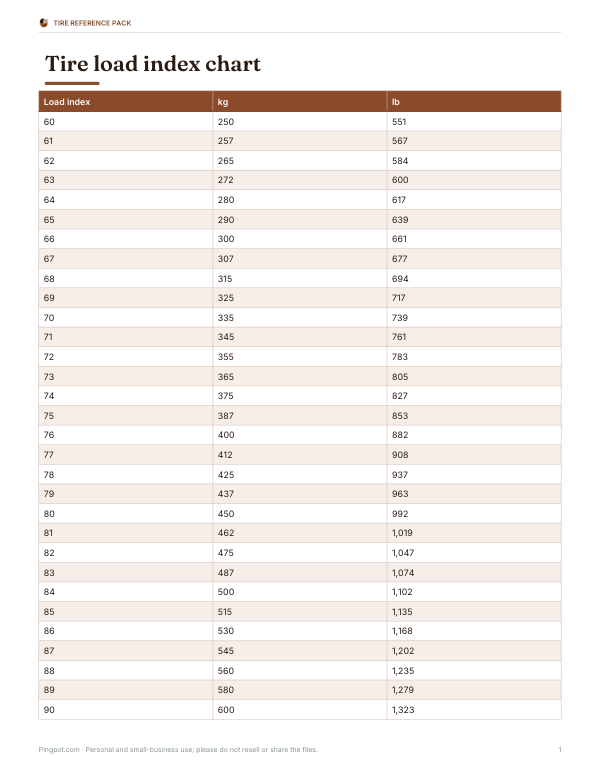
Load index chart
Tire Reference Pack
Printable tire reference: full load index chart (60–130) in kg and lb, speed rating card, sidewall decoding guide and a tire pressure and tread log.
- Load index chart (PDF/XLSX)
- Speed rating card (PDF)
- Sidewall guide (PDF)
- Pressure log (PDF/DOCX/XLSX)
Formats: PDF, XLSX, DOCX. Instant download after payment (link valid 72 hours, up to 5 downloads). AI-assisted: the templates were drafted with AI help and reviewed and laid out before publishing.
$3.00 USD, one-time 4 files · about $0.75 each
- Instant download
- 7-day refund
- Secure checkout by Stripe
7-day money-back guarantee. Full refund within 7 days of purchase, even after you download.
Free sample: Load Index Chart (PDF, 71 KB)
Full refund within 7 days — see the refund policy and license.
Free printables
Single sheets you can print right now, no sign-up. The full pack adds every sheet in one download plus the editable files.
 Printable Tire Pressure and Tread Log
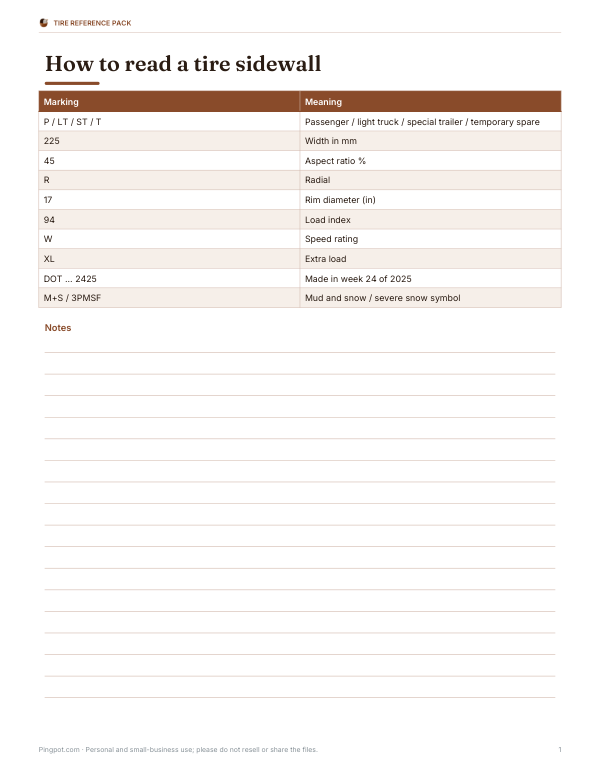
Reading the tire sidewall
| Part of 225/45R17 94W | Meaning |
|---|---|
| 225 | Section width in millimetres |
| 45 | Aspect ratio: sidewall height is 45% of the width |
| R | Radial construction |
| 17 | Rim diameter in inches |
| 94 | Load index: 670 kg (1,477 lb) per tire |
| W | Speed rating: up to 168 mph (270 km/h) |
| XL (if shown) | Extra load / reinforced: a higher load index at higher pressure |
A “P” before the size marks a P-metric passenger tire made to US standards; no prefix means a Euro-metric tire; “LT” means a light truck tire with two load indexes (single and dual fitment) and a load range letter.
Load index chart
| LI | kg | lb | LI | kg | lb |
|---|---|---|---|---|---|
| 60 | 250 | 551 | 96 | 710 | 1,565 |
| 61 | 257 | 567 | 97 | 730 | 1,609 |
| 62 | 265 | 584 | 98 | 750 | 1,653 |
| 63 | 272 | 600 | 99 | 775 | 1,709 |
| 64 | 280 | 617 | 100 | 800 | 1,764 |
| 65 | 290 | 639 | 101 | 825 | 1,819 |
| 66 | 300 | 661 | 102 | 850 | 1,874 |
| 67 | 307 | 677 | 103 | 875 | 1,929 |
| 68 | 315 | 694 | 104 | 900 | 1,984 |
| 69 | 325 | 717 | 105 | 925 | 2,039 |
| 70 | 335 | 739 | 106 | 950 | 2,094 |
| 71 | 345 | 761 | 107 | 975 | 2,150 |
| 72 | 355 | 783 | 108 | 1000 | 2,205 |
| 73 | 365 | 805 | 109 | 1030 | 2,271 |
| 74 | 375 | 827 | 110 | 1060 | 2,337 |
| 75 | 387 | 853 | 111 | 1090 | 2,403 |
| 76 | 400 | 882 | 112 | 1120 | 2,469 |
| 77 | 412 | 908 | 113 | 1150 | 2,535 |
| 78 | 425 | 937 | 114 | 1180 | 2,601 |
| 79 | 437 | 963 | 115 | 1215 | 2,679 |
| 80 | 450 | 992 | 116 | 1250 | 2,756 |
| 81 | 462 | 1,019 | 117 | 1285 | 2,833 |
| 82 | 475 | 1,047 | 118 | 1320 | 2,910 |
| 83 | 487 | 1,074 | 119 | 1360 | 2,998 |
| 84 | 500 | 1,102 | 120 | 1400 | 3,086 |
| 85 | 515 | 1,135 | 121 | 1450 | 3,197 |
| 86 | 530 | 1,168 | 122 | 1500 | 3,307 |
| 87 | 545 | 1,202 | 123 | 1550 | 3,417 |
| 88 | 560 | 1,235 | 124 | 1600 | 3,527 |
| 89 | 580 | 1,279 | 125 | 1650 | 3,638 |
| 90 | 600 | 1,323 | 126 | 1700 | 3,748 |
| 91 | 615 | 1,356 | 127 | 1750 | 3,858 |
| 92 | 630 | 1,389 | 128 | 1800 | 3,968 |
| 93 | 650 | 1,433 | 129 | 1850 | 4,079 |
| 94 | 670 | 1,477 | 130 | 1900 | 4,189 |
| 95 | 690 | 1,521 |
Values are the maximum load per tire at the tire’s maximum rated inflation pressure, following the standard load index table used by tire manufacturers. Capacity at lower pressures is lower — follow the pressure on your vehicle’s placard.
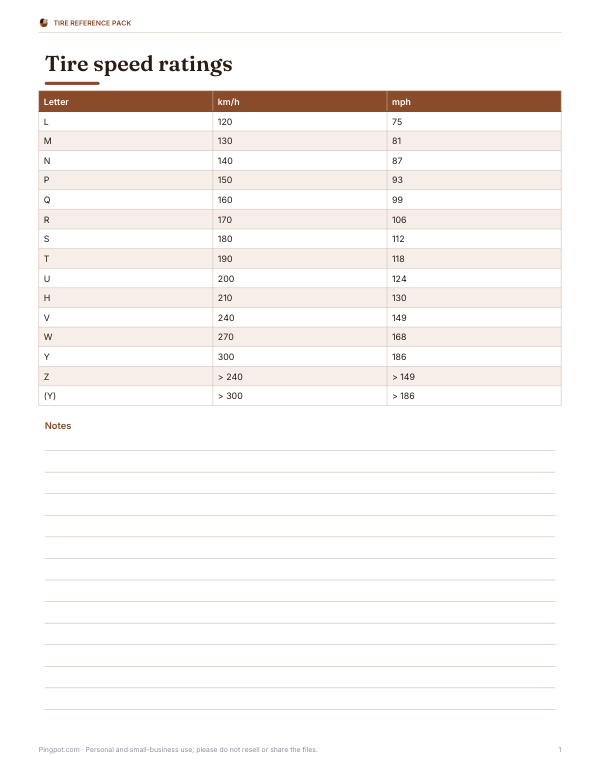
Speed ratings
| Letter | km/h | mph |
|---|---|---|
| L | 120 | 75 |
| M | 130 | 81 |
| N | 140 | 87 |
| P | 150 | 93 |
| Q | 160 | 99 |
| R | 170 | 106 |
| S | 180 | 112 |
| T | 190 | 118 |
| U | 200 | 124 |
| H | 210 | 130 |
| V | 240 | 149 |
| W | 270 | 168 |
| Y | 300 | 186 |
| Z | over 240 | over 149 |
| (Y) | over 300 | over 186 |
H comes after U, out of alphabetical order, for historical reasons. The speed rating is tested under specific laboratory conditions; it’s not a recommendation to drive at that speed, and a repaired, underinflated or overloaded tire may not be safe at its rated speed.
How to check the load index you need
- Find the tire placard on the driver’s door jamb or in the owner’s manual; it lists the original tire size, load index and speed rating.
- Replacement tires should have at least that load index and speed rating.
- For a check from first principles, find the gross axle weight rating (GAWR) for front and rear axles on the door-jamb certification label.
- Divide the heavier axle rating by two to get the load per tire.
- The tire’s capacity must be at least that — the tool above does this and suggests the minimum load index.
Worked example
A car’s door label gives a rear GAWR of 2,425 lb. Dividing by two gives about 1,213 lb per tire. A 94-load-index tire carries 1,477 lb, so it has a comfortable margin; a load index 86 tire (1,168 lb) would be too low. Now take an SUV with a GAWR of 3,900 lb fitted with P-metric tires: each tire must carry 1,950 lb, but P-metric tires on light trucks and SUVs are commonly derated by dividing their capacity by 1.1. A P265/70R17 113T tire carries 1,150 kg (2,535 lb) — 2,305 lb after derating — which is enough.
Extra load, reinforced and LT tires
- Extra load (XL) or reinforced tires carry more load than standard-load tires of the same size, but only when inflated to their higher maximum pressure.
- LT (light truck) tires show two indexes such as 123/120: the first for single fitment, the second for each tire in a dual-wheel set-up.
- LT tires also use a load range letter: C (6-ply rating), D (8-ply rating), E (10-ply rating) and so on; higher letters allow higher pressures and loads.
- Don’t mix load indexes on the same axle, and avoid fitting a lower load index than the vehicle manufacturer specifies — it can affect insurance and roadworthiness in some places.
Tire size maths
Sidewall height = width × aspect ratio ÷ 100. For 225/45R17, that is 225 × 0.45 = 101 mm. Overall diameter = rim diameter + two sidewalls = 17 × 25.4 + 2 × 101 = 634 mm (about 25.0 inches). When changing tire size, many fitters aim to keep the overall diameter within about 3% of the original so that the speedometer, ABS and stability systems read correctly — the decoder shows the diameter for comparing sizes.
Safety note
This page is for information. Tire choice affects braking, handling and safety — follow the vehicle manufacturer’s specification and the advice of a qualified tire fitter, and check tire pressures monthly when the tires are cold.
Frequently asked questions
What does the load index on a tire mean?
It is a code for the maximum load each tire can carry at its maximum pressure — for example, 94 means 670 kg (1,477 lb).
Can I use a higher load index than original?
Yes, a higher load index is generally acceptable; a lower one is not recommended.
What load index is 91?
615 kg (1,356 lb) per tire.
What does XL mean on a tire?
Extra load: the tire carries more weight than a standard-load tire of the same size when inflated to its higher maximum pressure.
Why do P-metric tires on SUVs get divided by 1.1?
The standard derates P-metric tires used on light trucks and SUVs to allow for heavier use.
What is the highest speed rating?
Y is up to 186 mph (300 km/h); (Y) in brackets means over 300 km/h.